What your ankle is trying to protect
It can be confusing when you can walk on it, yet the ankle still feels guarded—like it “catches” or gets tight after sitting, then loosens a little once you’re moving. That protecting feeling often shows up even when the sharp pain is gone, which can make the injury seem smaller than it is.
Part of what you’re noticing may be the joint’s built-in safety system staying turned up. When the ligaments are stretched or torn, the ankle may become less certain about where it is in space. Your brain tends to respond by increasing muscle stiffness around the joint and limiting how far you roll through the foot, because unpredictable motion is what can recreate the sprain position. Swelling adds to this by changing pressure inside the tissues and blurring the signals that normally help you “trust” each step.
This is why the ankle can feel fine during a short walk, then feel more sore or puffy later. The ankle isn’t always protecting against pain—it may be protecting against instability, and those two signals don’t always rise and fall together.
Ligaments, swelling, and the healing bottleneck
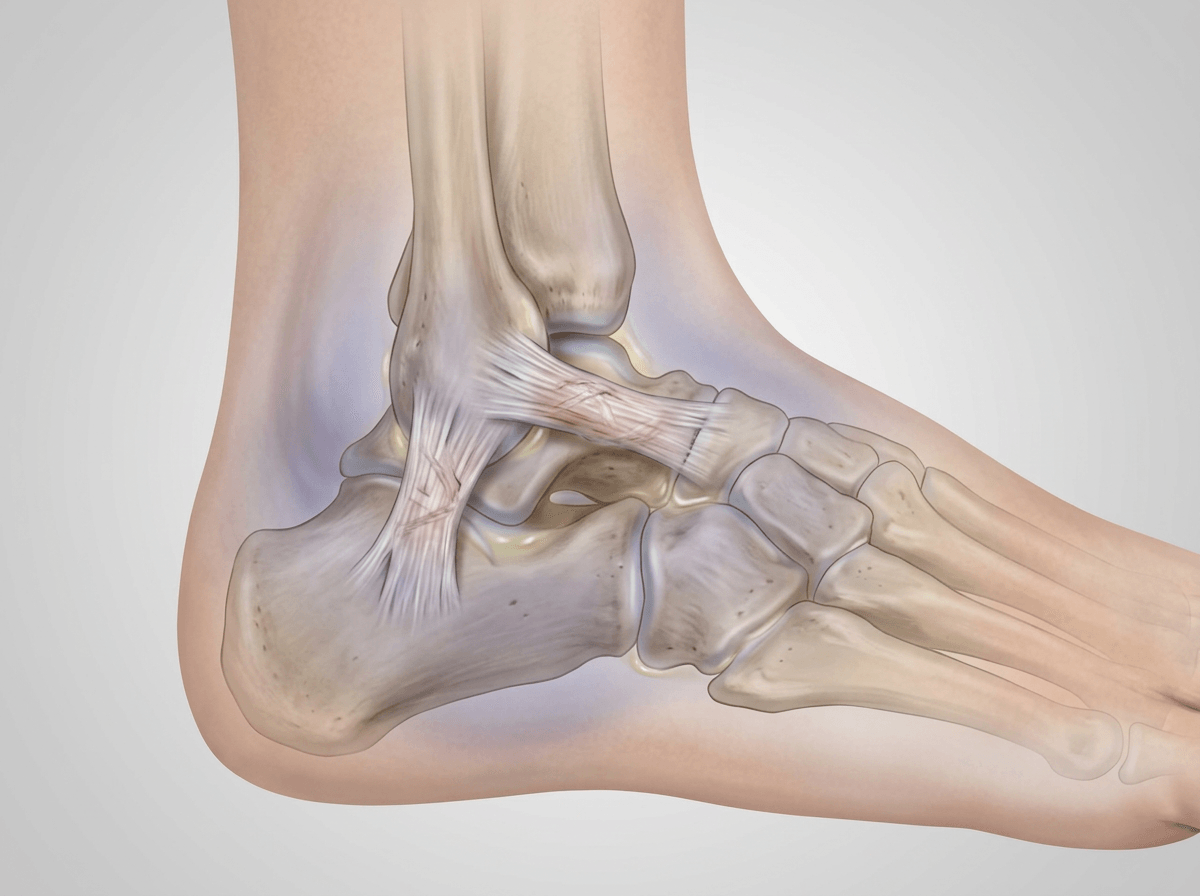
That lingering “full” feeling around the ankle—like the sock line leaves a deeper mark, or the joint looks slightly different by evening—often isn’t just leftover soreness. It’s a sign that fluid is still moving in and out of the tissues, sometimes in a way that doesn’t match how capable the ankle feels in the moment.
Ligaments heal slowly because they don’t have the same blood supply as muscle, and early repair tissue isn’t organized yet. Swelling can become a bottleneck here: extra fluid increases pressure, limits how well fibers line up, and can keep the ankle’s motion a little restricted. At the same time, swelling can dampen the joint’s position signals, so the stabilizing muscles may fire a fraction late—subtle enough that you only notice it as stiffness, clumsiness, or a vague “not quite right” step.
This is why a day can feel like progress, then the next morning looks puffier. The ankle may tolerate a dose of activity during the moment, but react to the total load afterward, especially with longer standing or uneven ground.
Why weight-bearing can feel safe, then fail
It’s often the next day that tells the truth: the ankle felt steady while you were walking, but later you notice a thicker outline, a stiffer first step, or a mild ache that wasn’t there during the activity.
In some cases, weight-bearing feels “safe” because the body can borrow stability from other places. You may shorten your stride, keep the foot more flat, or tense the muscles higher up the leg without realizing it. That strategy can mask what the injured ligaments and joint sensors still can’t do well yet—detect small shifts and trigger the right stabilizing muscles fast enough. Swelling can add to the confusion by dulling those position signals, so the ankle feels okay on predictable ground, then suddenly less trustworthy with a quick turn or an uneven surface.
When the borrowed stability runs out—fatigue, more steps, a slightly awkward landing—the ankle may “give” a little, not always as sharp pain, but as a brief wobble followed by more swelling afterward.
Healing time is a range, not a date
It can throw you off when the calendar says you “should be better,” but the ankle still looks a little thicker at night or feels stiff for the first few steps in the morning. That mismatch is common, because recovery rarely moves in a straight line—especially once you’re back to walking and the ankle is quietly dealing with hours of cumulative load.
Early on, swelling and tenderness are often the loudest signals. Later, even when pain is low, the repair tissue is still being reorganized and strengthened in response to what you ask of it. That remodeling process tends to be slower than people expect, and it can lag behind your confidence. The tricky part is that the ankle can feel “normal” during activity while the next-day response—puffiness, reduced range of motion, or a vague unstable step—suggests the dose was a little ahead of what the tissue can currently tolerate.
This is why two people with “the same sprain” can have very different timelines. Amount of swelling, how quickly motion returns, and whether the ankle ever has a brief giving-way moment all shape the range, and the signals can be inconsistent from one day to the next.
Exercises that rebuild control, not just strength
The first time you try a simple balance move—standing on the injured foot while you brush your teeth—it can feel oddly effortful, even if calf raises already seem “easy.” That mismatch is common, and it’s also where people get misled into thinking they only need to get stronger.
After a sprain, the ankle’s position sensors and the timing of the stabilizing muscles can lag behind. Strength can return faster than control, so the joint looks capable in straight-line tasks, but hesitates when tiny shifts happen under you. Balancing, slow single-leg hinges, and controlled step-downs work because they force the ankle to notice small wobbles and correct them quickly, rather than bracing with stiffness.
If you get next-day puffiness, a stiffer first step, or a brief “giving way” feeling later on, the challenge may have been the right type but too much dose for now.
The stretching mistake that can prolong irritation

It often shows up right after you’ve “loosened it up”: the ankle feels freer for an hour, then the outside edge feels hot or puffy again by evening. That can be confusing, because stretching seems like the responsible thing to do when stiffness is the main symptom.
A common mistake is pushing into end-range ankle inversion or aggressive calf stretching while the joint is still carrying extra fluid. Swelling changes the pressure inside the capsule and surrounding tissues, and the body tends to respond to that pressure with protective muscle tone. When you force range anyway, the irritated tissue can react by sending a sharper warning signal and drawing in more fluid afterward—so you get a short-term increase in motion, followed by a next-day “stuck” feeling.
This is also why stretching can feel productive during the moment but quietly slow progress: it can train you to chase sensation instead of noticing the delayed response. If the ankle is stiffer the next morning, or the swelling line looks higher after a stretch-heavy day, that pattern is worth taking seriously.
Prevention that actually reduces repeat sprains
The first time you step off a curb without thinking about it, there can be a split-second of hesitation—almost like the ankle “checks” the ground before you commit. That moment matters, because repeat sprains often happen when attention is elsewhere and the joint has to correct a small roll quickly, without bracing.
After a sprain, the ligament may tighten up over time, but the bigger lag is often the reflex side of stability. Swelling and pain can blunt the ankle’s position signals, and your brain may learn a stiff, flat-foot strategy that works on level ground but doesn’t train fast corrections. If that pattern sticks, the ankle can feel strong in the gym yet still misread uneven surfaces, especially with fatigue.
Prevention tends to look less like “more ankle work” and more like keeping the ankle honest: balance and landing control that stay clean when you’re tired, plus noticing the delayed flags. If “giving way” shows up, or next-day puffiness climbs after a return to sport or long shifts, that’s often a cue that stability is still catching up.