Why phone use creates neck and shoulder pain
It often starts as a dull pull at the base of the skull or a tight band across the tops of the shoulders after a long scroll—then eases, then comes back the next day. That inconsistency can make it feel like a “sleep wrong” problem, even when the trigger is simply how long your head and arms stayed in one position.
When a phone sits low, the head tends to tip forward and the shoulder blades drift slightly apart. The neck extensors and upper trapezius may stay lightly contracted to keep the eyes on the screen, while the muscles that normally share the job of holding the upper back “stacked” don’t get much variation. Because the position is small but sustained, fatigue can build without a clear moment of strain.
Over time, that steady load can irritate joints and soft tissues that prefer movement and changing angles. Early signs often show up as a mild headache after bed scrolling, a sore spot between the shoulder blades, or a feeling that the shoulders won’t “drop,” which is less mysterious when it’s understood as tissue tolerance being exceeded by a familiar pattern.
Static loading quietly overwhelms small stabilizer muscles
You may notice it most when you finally look up: the neck feels oddly heavy, the shoulders sit a little higher than you expected, and there’s a faint burn that wasn’t there a minute ago. Because nothing “hurt” while you were scrolling, it’s easy to assume the discomfort came from something else—stress, sleep, a bad pillow—rather than the stillness itself.
In a held phone posture, small stabilizer muscles around the neck and shoulder blades tend to work continuously at a low level to keep the head from dropping and the upper back from collapsing forward. That kind of steady contraction can reduce local blood flow and limit how quickly those fibers clear metabolic byproducts, so they fatigue in a quiet, smeared-out way instead of a sharp, obvious strain. The result can feel inconsistent: a session that seemed harmless can leave you tight later, while a shorter session on another day doesn’t.
Once those stabilizers tire, nearby muscles may start “helping” by bracing—often the upper traps, jaw, or muscles at the base of the skull—creating a more rigid holding pattern. It can be uncomfortable in a vague way, and it sometimes shows up as a headache, a sore edge along the shoulder, or the sense that you can’t find a truly neutral resting position afterward.
Forward head posture amplifies forces on cervical joints
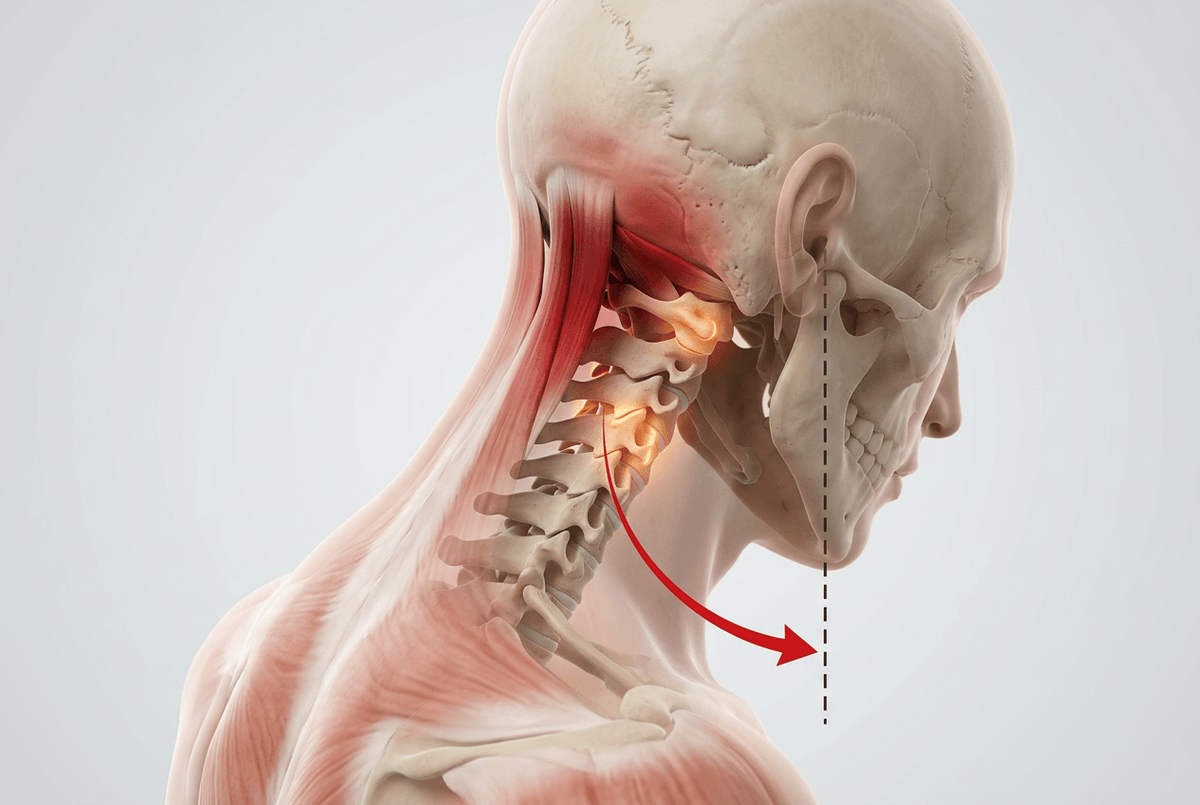
Sometimes you catch it in a reflection: your chin has drifted forward, the phone is near your lap, and your eyes are still trying to stay level with the screen. It can feel like a minor “slouch,” but the discomfort that shows up afterward—pinchy at the base of the neck, pressure-y behind the eyes, or a sore line along the upper traps—doesn’t always match how subtle the position looked.
What changes is leverage. As the head moves forward, the neck joints and discs aren’t just “bent”—they’re also dealing with a longer moment arm, meaning the tissues in the back of the neck have to generate more force to keep the head from dropping further. The facet joints and small muscles near the base of the skull may take more compressive load, while the front-of-neck tissues can stay lengthened and under-recruited in that position. Because the load creeps up gradually, it’s easy to misread the later ache as random, even when it’s the predictable outcome of holding that forward position long enough.
Once this becomes the default screen posture, the body often responds with small compensations—shoulders subtly rising, jaw clenching, or the head tilting back slightly to “find” the screen again. Those adjustments can be inconsistent from day to day, which is part of why the same amount of scrolling can feel fine one time and noticeably irritating the next.
Thumbs and wrists take repetitive, awkward micro-stresses
You might notice it first as a warm, slightly sore spot at the base of the thumb, or a tired feeling along the palm-side of the wrist when you finally put the phone down. Because the motions are small—and because your neck and shoulders are already taking your attention—it can be easy to dismiss the hand symptoms as “nothing,” until they show up again during the next long session.
One-handed scrolling tends to ask the thumb to do repeated arcs while also stabilizing the phone, and that combination can create friction where thumb tendons glide through tight tunnels near the wrist. At the same time, the wrist is often held in a subtly bent position, which can increase pressure through soft tissues that prefer a more neutral angle. The strain is rarely one big movement; it’s the accumulated micro-load of hundreds of near-identical reps, which can feel inconsistent—fine in the moment, then oddly sore later.
As those tissues get irritated, people often adapt without noticing: gripping harder, moving faster, or shifting to the other hand. That can spread the work around, but it can also keep the overall load high, so the “random” thumb or wrist ache keeps returning in a familiar pattern.
What drives the pattern beneath the surface
It can be surprising how often your shoulders creep up even when you don’t feel tense, especially if you’re trying to keep the screen steady while your eyes track fast-moving content. In the moment, it may feel like “just getting comfortable,” but the body is often making tiny bracing decisions over and over, without you noticing.
A big driver is attention. When your brain locks onto a task (replying quickly, reading closely, endless scrolling), it tends to reduce movement variety so the eyes and hands can stay precise. That “stillness strategy” keeps the neck extensors, upper traps, and small muscles around the shoulder blades lightly engaged for longer than they’re built to tolerate, while the jaw and forehead may tighten as part of the same concentration pattern. Because the effort is low-grade, it’s easy to misinterpret the later ache as random.
If the neck feels even slightly tired, you may unconsciously lean the head forward more or grip the phone harder to stabilize it, which further increases load through the same tissues. It’s not a single bad posture so much as a series of small, consistent compensations that add up.
Reasonable fixes that unexpectedly worsen discomfort
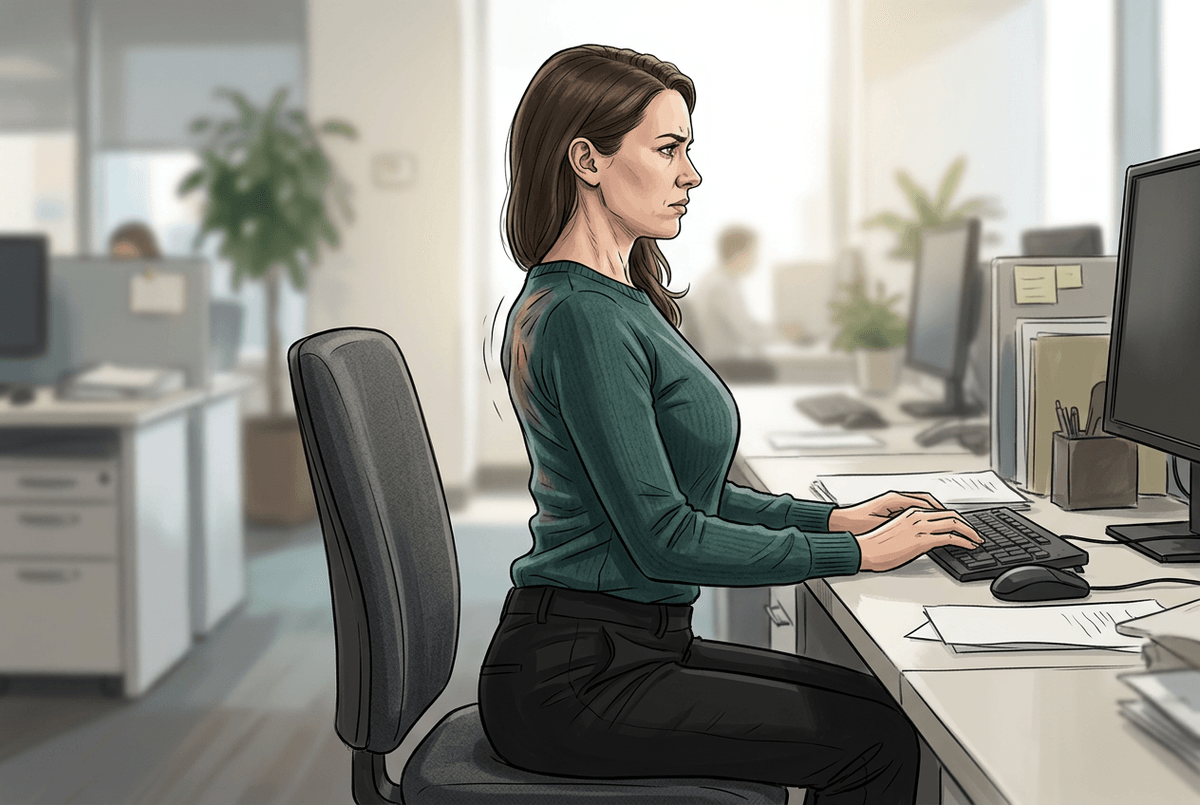
After a few days of tightness, it’s common to try “sitting up straight” by pulling the shoulders back and lifting the chest. In the moment it can feel cleaner, but if it turns into a held pose, it often becomes another form of static loading—now through the mid-back and the muscles between the shoulder blades—so the same fatigue shows up, just in a different spot.
Another reasonable move is bracing the core or tucking the chin hard to “fix” forward head posture. If the cue becomes forceful, some people end up compressing the small joints at the base of the neck or overworking the front-of-neck muscles that aren’t conditioned for sustained effort. Because it’s an all-or-nothing correction, the body may respond with more jaw clenching or shoulder elevation, which can make the discomfort feel confusingly inconsistent.
Even switching hands or using a tighter grip can backfire. It spreads the work, but it can also increase overall thumb and wrist tension, raising friction and pressure in tissues that were already getting irritated—so the phone use feels “fixed” while the soreness still returns afterward.
Low-friction adjustments that reduce cumulative tissue load
It’s often the first small shift that feels different: the shoulders drop a fraction, the jaw unclenches, and the screen suddenly seems easier to look at without “trying.” Not because anything got corrected perfectly, but because the load is no longer trapped in the same few tissues for as long.
What tends to matter most is changing the math of leverage and repetition. Bringing the phone closer to eye level shortens the moment arm on the neck, so the back-of-neck muscles don’t have to generate as much continuous force just to keep your gaze on the screen. Letting the forearms rest (on a pillow, armrest, or your torso) can offload the shoulder girdle, which reduces that quiet upper-trap bracing that builds when your arms hover.
Hand symptoms often respond to variety more than strength. Using two thumbs, switching to voice-to-text for longer replies, or scrolling with a finger instead of a hard-working thumb changes tendon glide patterns and reduces repeated friction in the same track. If discomfort is already showing up, it can help to treat it as an early “too much, too long” signal rather than something to push through on a better day.